LABORATORY OF RADIOBIOLOGY
Research

Laboratory of Radiobiology

Research

Research

Mechanisms and models of radiation response

Four connected programmes examine tumour radioresistance, systemic immune effects, three-dimensional tissue models and emerging high-dose-rate particle technologies.
01

p21 as a determinant of cancer-cell radioresistance

We investigate how p21-dependent arrest, DNA repair, survival and recovery shape tumour response to ionising radiation.

Ionising radiation creates DNA damage that can lead to death, durable arrest or recovery. The laboratory investigates p21 as a central regulator of this decision and examines how its cell-cycle, DNA-repair and stress-response functions contribute to radioresistance.

By comparing cancer and normal-cell systems across radiation qualities and schedules, the group seeks molecular signatures that distinguish protective arrest from irreversible loss of proliferative capacity and identify rational routes to radiosensitisation.
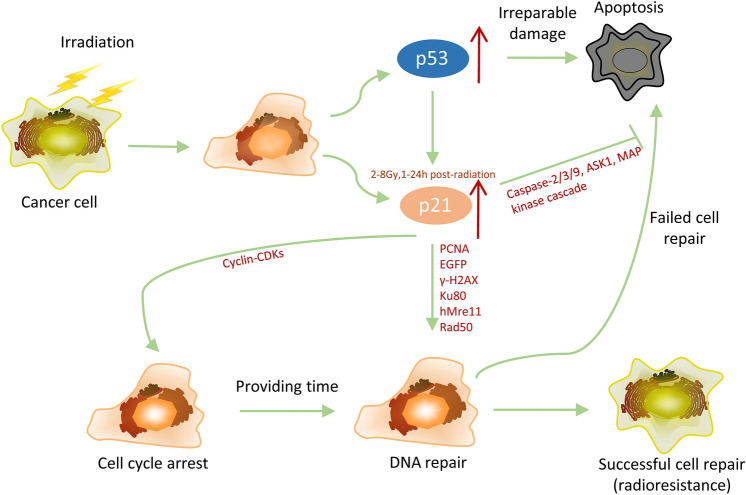
p21 helps determine whether irradiated cells repair damage and survive or enter cell death. Kuang et al., Journal of Cancer Research and Clinical Oncology (2021), open-access research figure.
02

Abscopal signalling and immunoradiobiology

We study how local irradiation generates immune and bystander signals that can influence disease beyond the treated field.

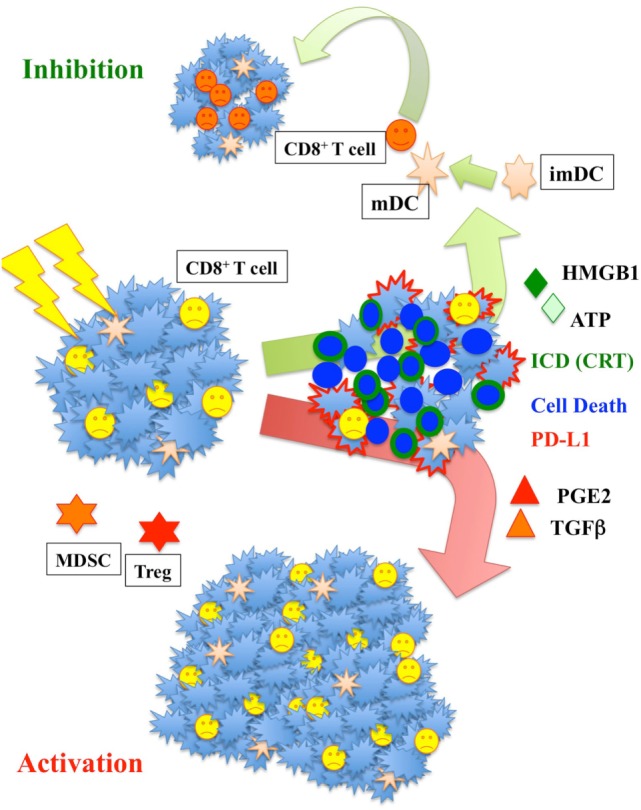
Radiotherapy can influence tumour biology outside the irradiated field. The laboratory investigates the molecular and cellular mechanisms underlying the abscopal effect and develops frameworks for evaluating combined immunoradiotherapy.

Particular attention is given to particle radiation, treatment fractionation and the balance between immune activation, tumour-cell death and normal-tissue effects.

Radiation-induced immune activation and counter-regulation in the tumour microenvironment. Ebner et al., Frontiers in Immunology (2017), CC BY.
03

Innovative 3D models of tumour and normal-tissue response

We develop spheroid and scaffold-based systems that reproduce tissue architecture, oxygen gradients and radiation responses more faithfully.

Flat monolayer cultures cannot fully reproduce gradients of oxygen and nutrients, cell–cell contact or extracellular matrix found in tissues. The laboratory therefore develops three-dimensional spheroid and scaffold-based cultures.

These systems are characterised for growth, viability, molecular response and radiosensitivity, providing experimentally tractable platforms for comparing tumour and healthy-tissue effects and testing new treatment combinations.

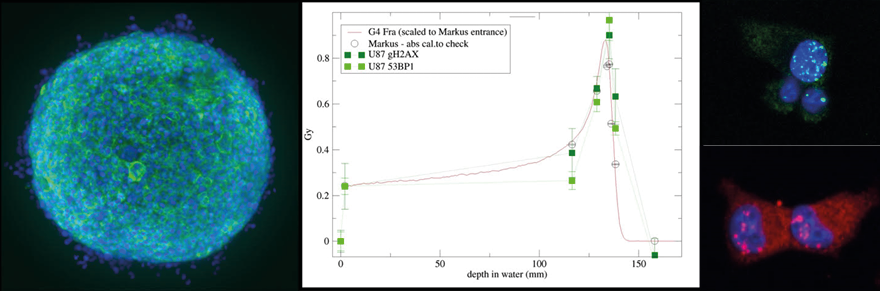
Three-dimensional spheroid models reveal radiation-response behaviour not captured fully by monolayer cultures. Wegge et al., International Journal of Molecular Sciences (2023), CC BY 4.0.
04

FLASH and high-dose-rate particle radiotherapy

We characterise biological responses to ultra-high-dose-rate and particle beams to understand how emerging modalities may widen the therapeutic window.

Charged-particle therapy can reduce dose to surrounding healthy tissue, while FLASH radiotherapy introduces ultra-high dose rates that may produce distinct biological effects. The laboratory studies how these modalities influence DNA damage, stress signalling, cell survival and immune responses.

Collaborations with physics, accelerator and biomaterials groups connect beam characteristics and dosimetry with biological endpoints in cancer and normal-cell systems.

ElectronFlash research accelerator for ultra-high-dose-rate irradiation. Di Martino et al., Frontiers in Physics (2020), CC BY.